
PROJECT INFORMATION:
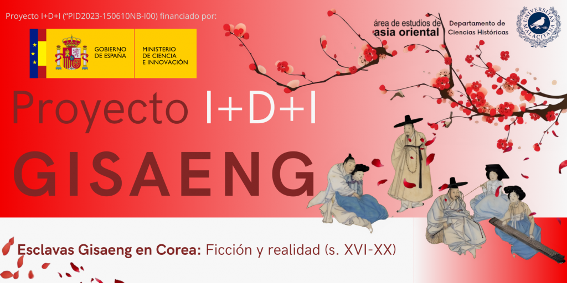
Project Title: Gisaeng Slave Women in Korea: Fiction and reality (16th–20th Centuries)
Acronym: Gisaeng
Principal Investigator: Aurelia Martín Casares
Reference: PID2023-150610NB-I00
Gisaeng Slave Women in Korea: Fiction and reality (16th–20th Centuries)
CONTEXT OF THE PROJECT
The GISAENG project is an R&D&i initiative funded under Spain’s 2023 National Plan by the Ministry of Science and Innovation. It is affiliated with the Department of Historical Sciences – Area of East Asian Studies at the University of Málaga. The project’s main objective is to investigate the historical and social role of the gisaeng in Korea—a unique form of female slavery that reflects class and gender inequalities in Korean society. Unlike other forms of slavery known in the West, slavery in Korea was primarily debt-based, and gisaeng were women of enslaved origin trained to entertain noble men. Although they share some similarities with Japanese geishas, gisaeng maintain distinct features rooted in Korean culture.
This project will help consolidate a research line on slavery already initiated within the Area of East Asian Studies. It will also provide resources for the research team and establish a framework for future doctoral dissertations. The project’s Principal Investigator is a member of the UNESCO International Scientific Committee for the Slave Route, which aims to break the silence surrounding historical slavery and gender hierarchies. The project is structured around several work packages: historiography and academic production on the gisaeng, artistic production (poetry, painting, theatre, and dance), their representation in Korean literature and in yadam (classical Korean prose narratives), as well as life histories and the religiosity of enslaved women. The analysis will focus on the late Joseon dynasty and the 20th century, when gisaeng were emancipated following the 1894 Gabo Reform and began to work as actresses and artists.
RESEARCH TEAM
Meet the members of the R&D project “Gisaeng Slave Women in Korea: Fiction and reality (16th to 20th centuries)”
Research Team
Aurelia Martín Casares: Project director
aureliam@uma.es
Antonio J. Doménech del Río: Researcher
ajdomenech@uma.es
Alicia Relinque Eleta: Researcher
relinque@ugr.es
Luis A. Botella Sánchez: Researcher
luisbotella@uma.es
Work Team
Eun Kyung Kang: Researcher
eunkang@uma.es
Patricia Chica Morales: Researcher
patriciacm@uma.es
Dong Kyu Kim: Researcher
Jung Kyung Kim: Researcher
César A. Ribas Ramírez: Predoctoral Researcher
cribas@uma.es
ACTIVITIES:
2025
- Participation in the 4th International Congress of the Spanish Association for East Asian Studies.
- Students from the Performing Arts course of the Degree in East Asian Studies are taking part in the activity “Gisaeng in Korean Literature.
- Research Methodology Workshop: Gender Aproach in Korean Studies.
PUBLICATIONS
Books
- Kang, E. K. (Ed.). (2025). Estudios sobre mujeres de Corea y Asia Oriental (1ª ed.). Dykinson. https://doi.org/10.14679/4082
Book Chapters
- Ribas Ramírez, C. A., & Martín Casares, A. (2025). Las mujeres de Corea representadas por el carácter gi en los Anales de la Dinastía Joseon (1392–1897). En E. K. Kang (Ed.), Estudios sobre mujeres de Corea y Asia Oriental (pp. xx–xx). Dykinson. https://doi.org/10.14679/4082
PROJECT INFORMATION:
Project title: The Road to Freedom in the Joseon Period in Korea: Slavery and Abolitionism in the East Asian Context.
Acronym: ASIA-SLAVES
Principal Investigator: Aurelia Martín Casares
The Road to Freedom in the Joseon Period in Korea: Slavery and Abolitionism in the East Asian Context
CONTEXT OF THE PROJECT
The present ASIA-SLAVES is an R+D+i project of the National Plan 2020 granted by the Ministry of Science and Innovation, attached to the Department of Historical Sciences – East Asian Studies Area of the University of Malaga. The main objective of the project is to investigate the processes of perpetuation and subsequent abolition of slavery in Korea during the Joseon period.
In contrast to slavery by war (prisoners of war), by trade (the slave trade) or by birth, typical of Europe and its colonies, the main mode of acquisition of slaves in Korea until the Kabo Reform of 1894 was debt (indebtedness could involve the sale of one’s children or oneself). In addition, Korean slavery has particularities that do not exist in the Western context, such as gisaeng (female slaves dedicated to the entertainment of men). In addition, revealing the role of these women from a gender perspective is also of interest to the feminist studies movement in South Korea, which is currently experiencing a boom in universities.
This project has a clearly international vocation, and is immersed in international thematic networks on slavery. Our intention is to consolidate our team as an international leader in Asian slavery studies at a global level and to contribute to the maximum dissemination of this project.
PROJECT MEMBERS
Meet the members of the R&D Project “The Path to Freedom in Abolitionism in the Context of East Asia”
Research Team
Aurelia Martín Casares: Project director
aureliam@uma.es
Antonio J. Doménech del Río: Researcher
ajdomenech@uma.es
Alicia Relinque Eleta: Researcher
relinque@ugr.es
Luis A. Botella Sánchez: Researcher
luisbotella@uma.es
Work Team
Hyun Woo Cho: Researcher
Dong Kyu Kim: Researcher
Young Il Ko: Researcher
Eun Kyung Kang: Investigadora
eunkang@uma.es
Patricia Chica Morales: Researcher
patriciacm@uma.es
Estrella Vivas Bellido: Researcher
estvivbel@uma.es
Virginia Rueda González: Researcher
virginiarg@uma.es
César A. Ribas Ramírez: Researcher
cribas@uma.es
Laura Quirós Fuentes: Researcher
laurafquiros@uma.es